Ето превода на статията на английски език, подготвен за професионално публикуване, без разделителни черти и с терминология, подходяща за оптика:
Sports Protective Eyewear: Safety and Clear Vision on the Field
Sports are not only a physical exertion but also a visual challenge. In a dynamic environment where decisions are made in fractions of a second, vision is the brain's primary source of information. For people who wear prescription glasses, choosing the right equipment is often the difference between the enjoyment of the game and the risk of a serious injury. Very often, however, both children and adults compromise by stepping onto the field with their everyday glasses or, even worse, without any correction at all. In the following lines, we will examine in detail why specialized sports protective eyewear is indispensable and what you need to know about its specific optics.
Why are everyday glasses dangerous during sports?
One of the greatest misconceptions is that standard prescription glasses are sufficient for sports activity. The problem here is not the prescription itself, but the construction. Everyday frames are designed for static wear or light movement. They are often made of metal, acetate, or brittle plastic, which break into sharp fragments upon impact. Imagine a collision during a basketball game – an opponent's elbow hits your face. If you are wearing a metal frame, it can bend and injure the skin or, in the worst-case scenario, cause a serious injury to the face or eye.
Sports protective glasses are designed to a completely different standard. Their materials are shock-absorbing, and the lenses are made of polycarbonate – a material used in the windshields of fighter jets.
Anatomy of a sports frame: What makes it "protective"?
To understand why these glasses are so effective, we must look at their construction. They are equipped with special shock-absorbing elements. These are usually soft silicone pads on the nose and the inner side of the temples. These components distribute the impact energy over a larger area of the face, reducing the risk of injuries.
Additionally, the attachment method is key. Unlike the temples of regular glasses, which easily slip off due to sweat or sudden movement, sports models use adjustable elastic straps. These fix the glasses tightly to the head, which is critical in sports like football or volleyball, where there are constant jumps and changes in direction.
The specifics of curved frames and the challenges of high prescriptions
Here we come to one of the most important and frequently discussed topics – visual comfort. Sports glasses are almost always curved (the so-called "wrap-around" design). This shape is not just for aesthetics; it aims to offer maximum peripheral vision and protect the eye from the side. However, when we place a prescription lens in such a frame, the physics of light refraction changes.
With standard glasses, the lens sits almost parallel to the pupil. With sports glasses, the lens is at an angle. This leads to the so-called "prismatic effect." If your prescription is high, this can lead to a sensation that objects are closer or further than their actual location. Peripheral vision may appear slightly blurred or "swimming."
Adaptation and technological solutions for high prescriptions
For people with high prescriptions (above +/- 4.00), it is important to know that adapting to sports glasses is a process. The brain must learn to ignore peripheral distortions. In the beginning, you might feel slightly dizzy, but this is normal. The best way to get used to them is to wear them at home for 15-20 minutes a day for a few days before your first practice.
The choice of lenses plays a crucial role here. Although more expensive, the right lenses are an investment that ensures you won't miss a pass due to a wrong judgment of distance.
Glasses for team sports: Basketball, Football, Volleyball
In team sports, contact is inevitable. In basketball, for example, one of the most common injuries is an eye injury during a struggle for the ball. Sports glasses act as a shield here. It is important to choose a model with good ventilation. During intense play, the body releases a large amount of heat. If the frame is too enclosed, the lenses will fog up in seconds, making you functionally blind on the field. It is advisable to use anti-fog sprays, which add protection against fogging.
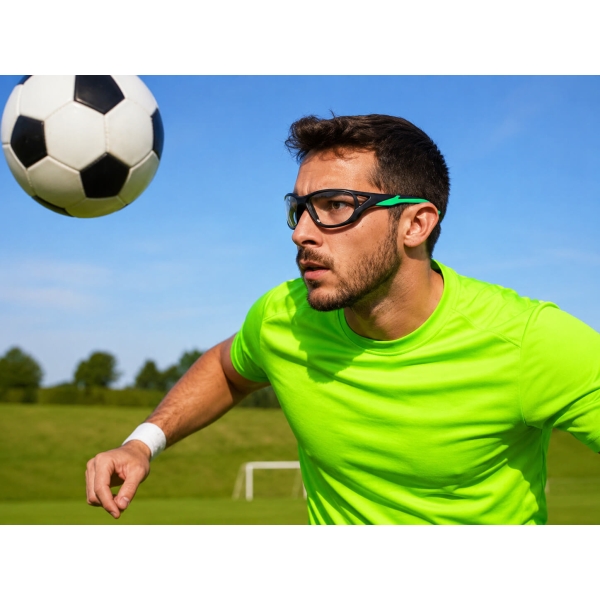
In football, the situation is similar, but the factor of weather conditions is added. Playing in rain or fog requires lenses with a hydrophobic coating, which prevents droplets from staying on the surface. Also, for football players, the durability of the frame against ball impact is vital – the pressure in a football is high, and the impact can be extremely destructive to ordinary plastic.
Sports eyewear for cyclists and athletes
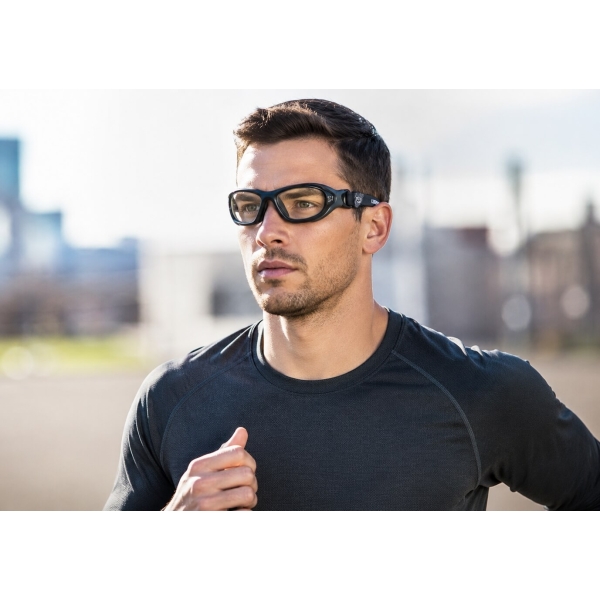
Cycling requires a different type of protection. Here, the primary risk is not an impact from an opponent, but speed, wind, and foreign bodies (insects, dust, pebbles). Cycling sports prescription glasses are often lighter and have thinner frames to fit under the helmet. The curvature here is critical to stop the airflow that dries the eye and causes involuntary tearing. During climbs at low speed, fogging is again a problem, so ventilation at the top of the frame is a priority.
Specifics for children: Why protection is critical at a young age?
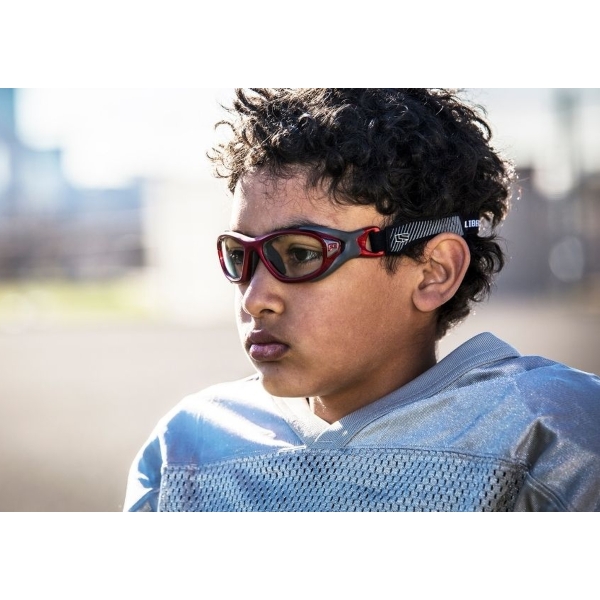
Children are much more susceptible to sports injuries because their coordination and sense of self-preservation are still developing. A child with a prescription who tries to play without glasses is often labeled as "clumsy," which can lead to them giving up sports. If they play with everyday glasses, the risk of breakage is a constant source of stress for parents.
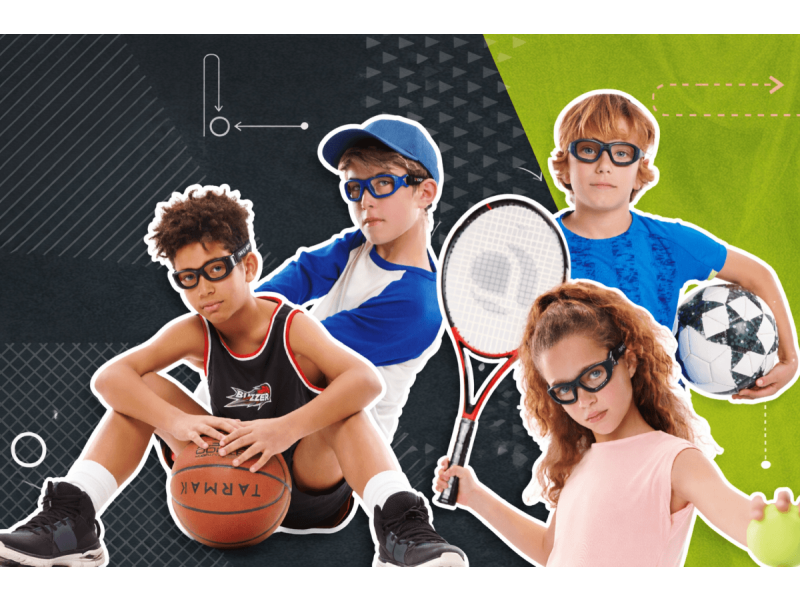
Sports glasses for kids are not just an accessory; they are a tool for socialization. They allow the child to see the ball clearly and participate actively in the game. It is important for parents to pay attention to size. A child's face changes quickly. A frame that is too small will cause headaches, and the child will refuse to wear it. A frame that is too large will slide down and interfere with focus.
Lens materials: Standard vs. High-Index
When ordering sports glasses, you will face a choice of lens material. There are two main materials:
Standard Polymer: This is the most common type. Over the years, it has replaced quartz glass and is extremely strong, lightweight, and has built-in UV protection. Its main disadvantage is that it lacks the necessary thinness, which becomes visible when prescriptions are high. It is also not as strong compared to high-index options.
High-Index (Thinned): This is the more modern material. It is stronger and more impact-resistant than the standard one. It is lighter and offers the same optical quality as the standard polymer.
Common problems during use and how to handle them
The most common problem is fogging. Even the most expensive glasses can fog up under certain conditions. The solution is a combination of good frame ventilation and the use of specialized anti-fog spray. Another problem is maintenance. The sports environment is full of sweat, which is salty and can corrode some lens coatings over time. Therefore, it is mandatory to wash the glasses after every workout with lukewarm water and neutral soap, then dry them with a soft microfiber cloth.
Often, users complain that the glasses "move." This usually means the strap is loose or the nose pad is not correctly positioned. Sports glasses require fine-tuning, which sometimes takes time but is key to comfort.
The psychological aspect: Feeling confident with your gear
Sports are as much about the mind as the body. When you know your eyes are protected and that you see everything on the field, you play more boldly. This is especially important for children. Modern designs of sports eyewear now look very professional and athletic – they resemble the gear of professional athletes, which helps kids feel like "superstars" on the field rather than "the kid with glasses."
The choice of sports protective eyewear is an investment in the health and longevity of your vision. Whether you are a parent of a young football player or a passionate cyclist or basketball player yourself, do not compromise on safety. Yes, seeing through a curved frame requires a period of adjustment, especially for more complex prescriptions, but the benefits of full protection and crystal-clear vision on the field are incomparable.
At Blink.bg, we believe that every athlete deserves the best visual support. Explore our sports eyewear offerings and consult with our specialists to find the model that will make you faster, more accurate, and above all – protected.