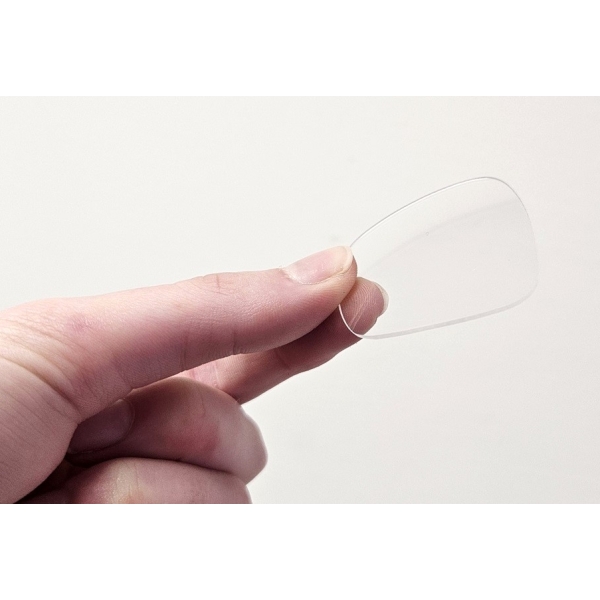
Choosing new prescription glasses often brings us face-to-face with technical terms that sound complicated but are crucial for how we perceive the world. One of the most important components in modern optics is the anti-reflective (AR) coating. Often taken for granted, it is the result of decades of scientific research in the physics of light. But why do manufacturers actually put this thin layer on the lenses, and what is its real role in our daily lives?
Why Does Anti-Reflective Coating Exist?
The main reason for the existence of AR coating is the nature of light itself. When light hits the surface of a standard uncoated lens, about 8% to 12% of that light reflects back instead of passing through to the eye. This creates two main issues. First, the wearer sees a darker, less contrasted image because less light reaches the retina. Second, reflections on the lens surface prevent others from seeing your eyes, creating a "mirror" effect. AR coating is designed to eliminate these reflections through destructive interference, allowing up to 99% of light to pass through. This makes vision crystal clear, especially when driving at night or working on a computer.
Easy Cleaning: Myth or Reality?
Many users believe that simply purchasing glasses with AR coating means they will automatically be easier to clean. The truth is that "easy cleaning" is not an inherent property of the AR itself, but of the additional layers applied on top of it. Basic AR coatings can actually act as a magnet for fingerprints and oils. High-quality coatings found in a reputable online optician store include hydrophobic (water-repellent) and oleophobic (oil-repellent) layers. The higher the grade of the coating, the more "slippery" the surface, allowing a microfiber cloth to remove dirt in one swipe instead of smearing it.
The Fogging Problem
Fogging when moving from cold to warm environments is a physical process (condensation) that is difficult to stop entirely. However, the quality of the AR package plays a key role in how quickly your glasses "clear up." In high-quality coatings, the super-hydrophobic layer prevents microscopic water droplets from forming a dense film. Instead, they bunch into larger droplets that evaporate or slide off much faster. If your glasses remain fogged for a long time, it is a clear sign of a lower-grade or worn-out coating.
Scratch Resistance: Expectations vs. Reality
A common misconception is that expensive AR coatings make lenses "scratch-proof." It is important to be realistic: in modern optics, there is no organic (plastic) lens that is completely immune to scratches. However, a quality coating includes a hard coat that significantly increases the material's durability. Cheap coatings have fragile AR layers that can be scratched even by dust particles on your cloth. Quality AR is a multi-layered structure acting as a shield, but it still requires proper care—washing with lukewarm water and soap before drying.
What Damages Anti-Reflective Coating?
AR coating is delicate and affected by the environment. The biggest enemy is high temperature. Leaving glasses on a car dashboard in summer or exposing them to steam over a cooking pot can cause the coating to "craze" or crack. This process is called thermal shock and is irreversible. Chemicals like hairspray, strong cleaners with ammonia, or even salty sea water can also corrode the coating. When the AR is compromised, it starts looking like an "oily smudge" or "peeling" that cannot be cleaned. In such cases, the only solution is lens replacement.
Frequently Asked Questions (FAQ)
Why do anti-reflective lenses have a colored reflection (green, blue, or purple)? This is known as residual reflection. It is specific to the manufacturing technology and does not affect the color of the image you see. Different manufacturers use different colors as their "signature" or for specific purposes (like blue coatings for computer protection).
Can AR be repaired if it gets scratched? Unfortunately, once scratched or cracked, the AR surface cannot be restored. Its application occurs in vacuum chambers under specific conditions that cannot be replicated outside a factory setting.
How long does an AR coating last? With good maintenance, a high-quality coating maintains its properties for 2 to 3 years. After this period, the hydrophobic layers begin to wear down, and the glasses start getting dirty more easily.
Is AR necessary if I only wear reading glasses? Yes, as it reduces visual fatigue. Artificial indoor lighting often creates reflections on the inner surface of the lenses, which puts unnecessary strain on the eyes.