Which Eyeglass Frames to Choose for High Prescriptions?
Choosing the right frames is not just a matter of style—it is crucial for the final appearance of your lenses, especially if you wear high prescriptions. In this article, we will examine which types of frames are best suited for high plus or minus powers, how to avoid the visual drawbacks of thick lenses, and what to consider regarding materials, design, and manufacturing technology.
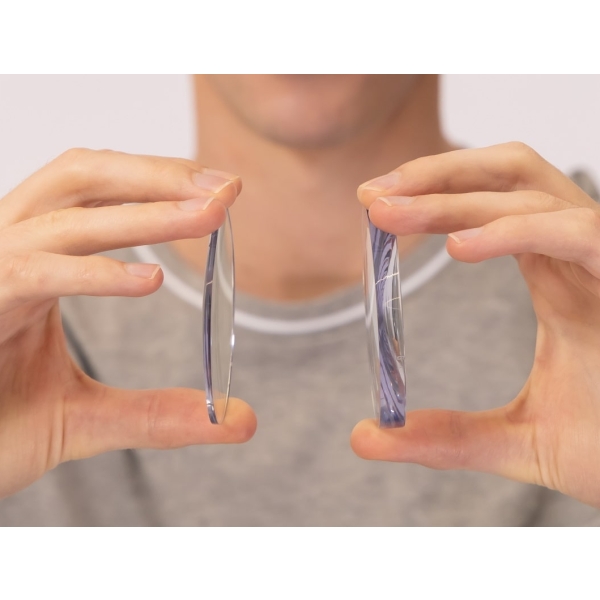
1. What High Prescriptions Mean for the Appearance of Your Glasses When we speak of "high prescriptions," we usually refer to values above +4.00 or higher than -4.00. These powers require thicker lenses, whether for farsightedness (hyperopia) or nearsightedness (myopia). The shape and construction of the frame significantly influence whether the lenses will look noticeably thick, "protrude" from the frame, or blend in harmoniously and aesthetically.
2. Why High Prescriptions Look Better in Full-Rim Frames The best solution for people with high prescriptions is a full-rim frame—one that encloses the lens on all sides. It can be metal or plastic. The reason is simple: with high powers, especially plus prescriptions, the lenses are thickest in the center and thin out toward the edges. A full-rim frame hides the thickness of the edges and creates a finished look. Plastic frames generally perform this task much better. Semi-rimless (supra) or rimless (drill-mount) glasses are unsuitable because:
-
With plus prescriptions: The lens bulges forward and looks "clunky" without a full frame.
-
With minus prescriptions: The lens edges are thick and remain completely visible without a frame.
-
Rimless designs: They often cannot stably support the weight of thick lenses, making them impractical.
3. Frames for High Plus Prescriptions (Farsightedness) Plus lenses (e.g., +5.00, +6.00 and up) push the image forward and visually enlarge the eyes. To minimize this effect:
-
Choose small to medium-sized frames: This uses a smaller lens surface area.
-
Avoid rimless and clip-on frames: Because the center of the lens is convex, the effect is too visible without a solid frame.
-
Prefer plastic frames: Especially colorful or thicker models, as they successfully mask lens thickness.
-
Choose round or oval shapes: These allow the lens to thin out more evenly without sharp corners that create extra thickness.
-
Always use thinned lenses: A refractive index of 1.6 or higher (e.g., 1.67) will significantly improve the look of the glasses.
4. Frames for High Minus Prescriptions (Nearsightedness) Minus prescriptions (-4.00, -6.00 and down) have the opposite effect—they visually reduce the size of the eyes, and thickness is concentrated at the periphery. When choosing for minus powers:
-
Avoid large frames: Larger frames require lenses to cover a wider area, increasing both thickness and weight.
-
Aviator frames are unsuitable: Their wide, downward-elongated shape requires larger lenses with thick outer edges.
-
Choose small or medium round/rectangular frames: They require less material and visually "hide" the thickness of the lenses.
-
Prefer full frames: These are best for concealing the thick edges of minus lenses.
-
High-index lenses (1.6 or higher): These are nearly mandatory to keep the glasses balanced and lightweight.
5. Special Case: Clip-on Frames with High Prescriptions Frames with magnetic clip-on sun attachments are very convenient, but with high prescriptions, you must be careful:
-
With high plus powers: These frames are often unsuitable because the lenses are too convex, creating a gap or preventing the clip-on from attaching securely, which risks scratching.
-
With rimless clip-on designs: The weight of thick lenses can disrupt the alignment or damage the frame itself. If you want a clip-on with a high prescription, choose a solid, stable plastic frame with a high-quality magnetic system and consult a specialist.
6. High-Index (Thinned) Lenses – Always a Good Idea Regardless of your prescription type, thinned lenses are recommended for balance, weight, and comfort:
-
1.6 Index: A great compromise between price and thinness. Suitable for powers from ±3.00 to ±6.00.
-
1.67 or 1.74 Index: Thinner and lighter, specifically suited for prescriptions over ±6.00.
-
For Plus powers: High index reduces both thickness and the forward bulge of the lens.
-
For Minus powers: High index reduces the thick edges visible from the side.
7. Additional Tips for Aesthetic and Comfortable Choices
-
Choose matte or translucent frames: They soften the boundaries of the glasses and draw less attention to the lenses.
-
Avoid transparent or very thin frames: They cannot hide thick edges.
-
Opt for anti-reflective coatings: Essential for clarity, especially for screen use and night driving.
-
Consult an experienced optician: Small errors in centering can lead to significant discomfort with high prescriptions.
Choosing the right frame for high prescriptions is a blend of practicality, aesthetics, and functionality. Full frames, smaller sizes, and high-index lenses are your best allies.