Choosing the right lenses is just as important as picking the frame itself. Whether you are looking for fashion-forward frames or functional prescription frames for daily use, the combination of the two is crucial for the comfort, appearance, and effectiveness of your eyewear.
In this article, we will explore the factors you should consider to ensure your lenses pair perfectly with your chosen frames, especially for more complex corrections like nearsightedness or farsightedness.
1. Pay Attention to Pupillary Distance (PD)
Pupillary Distance (PD) is the distance between the centers of your pupils. It is vital for centering the optical power of the lenses correctly.
-
The Risk: If you choose an oversized frame but have a small PD (e.g., under 60 mm), the optical centers of the lenses may not align with your pupils. This can make it impossible to manufacture the glasses accurately.
-
Tip: If your PD is smaller than average, avoid very wide frames. Opt for medium or compact shapes that allow for proper lens placement.
2. High Minus Prescriptions – Avoid Large Frames
If you wear glasses for nearsightedness (myopia) with high minus powers (-4.00 and up), large frames are generally not recommended.
-
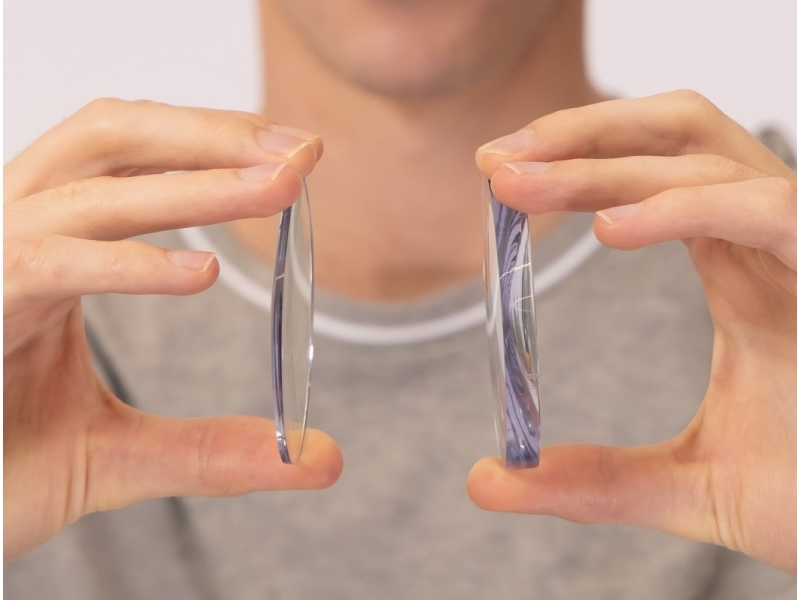
The Reason: Minus lenses are thinner in the center and thicker at the edges. The larger the frame, the thicker the visible edges become. This also increases the weight, leading to nose fatigue.
-
Tip: Stick to small or medium frames and avoid massive models. High-index lenses are very beneficial here—specifically, a refractive index of 1.6 is often the "sweet spot" for minus powers.
3. High Plus Prescriptions and Clip-on Frames – A Difficult Match
For farsightedness (hyperopia) with high plus powers (e.g., above +3.00), be careful with clip-on (forehanger) frames.
-
The Reason: Plus lenses are thickest in the center and highly convex (bulging). When a magnetic sun clip is added, the glasses become heavier. In some cases, the clip-on might not even attach properly because the lens bulge gets in the way.
-
Tip: Choose compact frames and consult a specialist to ensure the frame can safely accommodate a clip-on with your specific prescription.
4. High Cylinders or Astigmatism – Prioritize Stability
Stability is key for astigmatism. Even a slight twist or misalignment of the frame can shift the optical axis, causing blurriness or dizziness.
-
The Reason: Astigmatism lenses can start to take on a "crescent" shape even at lower values, which affects the final look.
-
Tip: Look for standard "flat" frames rather than curved sports designs. Avoid very thin or flexible frames; instead, choose sturdy, thicker models that hold the lenses securely in place.
5. Progressive Lenses – Avoid Shallow Frames
If you wear progressive lenses, the vertical height of the frame is critical. These lenses need enough space to transition smoothly from the distance zone at the top to the reading zone at the bottom.
-
Tip: Avoid "retro" or narrow frames with limited height. Ideally, look for frames with an aperture height of at least 37 mm.
6. Frame Material Dictates Lens Choice
Different frame types work better with specific lens materials:
-
Metal Frames: Often require thinner lenses, especially for semi-rimless (supra) or rimless (drill-mount) designs.
-
Full Plastic/Acetate Frames: These are forgiving and can accommodate almost any lens thickness, effectively hiding thicker edges.
-
Clip-on Frames: Require lightweight lenses for comfort. High-index (thinned) lenses are almost always the best choice here, particularly for plus prescriptions.
7. Refractive Index – For Aesthetics and Weight
The refractive index determines how thin your lenses will be. The higher the index, the thinner and lighter the lens.
-
Tip: For strong prescriptions, combine a compact frame with a high index (e.g., 1.61 or 1.67) to achieve an elegant, lightweight result.
Summary
Choosing the right lenses isn't just about the numbers on your prescription—it's about how the frame, lens material, and your facial measurements work together. To ensure the best result, always consider your PD, the type of diopter, and the frame's structural integrity.