Buying glasses is much more than choosing a fashion accessory. It is a medical device that directly affects your daily comfort, eye health, and the way you perceive the world. The process can be complex, as it combines facial anatomy, optics, and materials science. To make the right investment, it is essential to understand the details that often remain hidden behind beautiful storefront displays.
Frame Geometry and Anatomy: Why Size Matters. When you try on a frame, the first sensation is usually aesthetic. However, optics begins where the mirror ends. One of the most critical components is the temple length. If the temple is too short, it will exert constant pressure behind the ear, leading to headaches and discomfort after just an hour of wear. Conversely, a temple that is too long cannot be properly curved behind the ear, causing the glasses to constantly slide down your nose. This is not just annoying—it changes the focal distance of the lens and degrades visual quality.
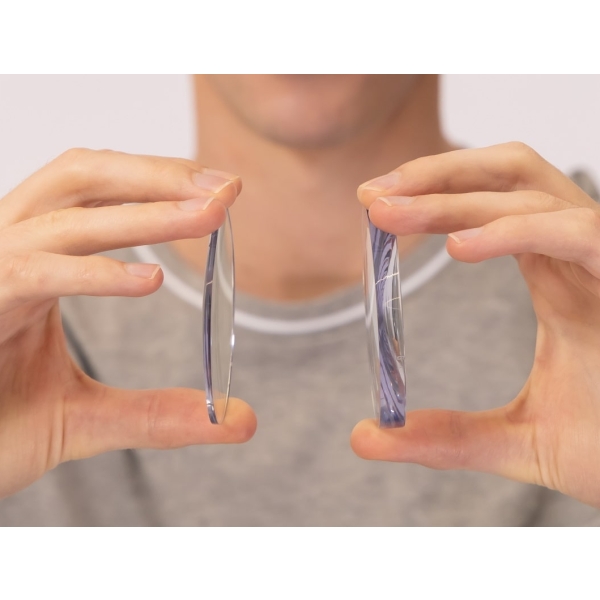
Frame Size and High Prescriptions. Here, aesthetics often conflict with physics. If your prescription is above +/- 3.00, choosing a very large ("oversize") frame is not recommended. For "minus" lenses, the edges become thicker as the diameter increases. In a large frame, the thickest part of the lens remains visible, making the glasses heavy and visually unappealing. For "plus" prescriptions, a large frame makes the lens very bulbous and heavy in the center.
The Curvature of the Frame. Most prescription lenses are relatively flat. If you choose a sporty, highly curved frame, mounting standard lenses will strain the frame or lead to peripheral distortions known as the "prismatic effect." This causes faster eye fatigue and, in some cases, dizziness. While special high-curvature lenses exist for sports frames, they can still present visual challenges for those with high prescriptions or astigmatism.
Mechanical Strength: The Flex Hinge and Our Habits. Most modern frames are equipped with a spring mechanism called a flex hinge. It allows the temples to open slightly wider than standard, providing a softer fit and protecting the frame from deformation. However, the flex hinge has one great enemy: removing glasses with one hand. When you pull your glasses off by a single temple, you exert immense pressure on the opposite hinge. Over time, the spring stretches or snaps. Regardless of your frame's quality, the rule is simple: always put on and take off glasses with both hands.
Lenses: Technology That Protects the Eyes. If the frame is the body, the lenses are the soul of the glasses. The most vital element here is the anti-reflective (AR) coating. Standard uncoated lenses reflect about 8-10% of the light that hits them, creating "ghost" images and glare. An AR coating allows 99% of light to pass through to your eye. The image is clearer, the contrast is higher, and the eyes strain less. This is why AR coatings are standard for almost all optical lenses today.
Classes of Anti-Reflective Coatings and Durability. Not all coatings are created equal. We can generally divide them into three classes:
-
Basic Class: These provide good transparency but scratch relatively easily and smudge quickly. Their lifespan is about 1–2 years with careful care.
-
Middle Class: These feature better hydrophobic (water-repellent) properties. They are easier to clean and last about 2–3 years.
-
Premium Class: These include layers for hardness, anti-static properties (to repel dust), and super-hydrophobicity. They are extremely scratch-resistant and can last 4+ years in excellent condition with proper maintenance.
Damaging the Coating. The fastest way to destroy an AR coating is exposure to high heat—such as hair dryers, ovens, saunas, or leaving glasses on a car dashboard in summer. The coating layers and the lens material expand at different rates, leading to "crazing"—a web-like cracking effect that cannot be repaired.
Digital Life: Anti-Reflective vs. Blue Cut Filters. Many people believe a standard AR coating is enough for screen work. This is a myth. Standard AR simply makes the lens more transparent. For screen use, you need a Blue Cut (or Blue Control) filter. Digital devices emit high-energy blue light that suppresses melatonin and causes dryness and strain. A Blue Cut filter is a specific coating that reflects this harmful spectrum. If you spend more than 3 hours a day in front of a screen, standard AR will not protect you from digital eye strain as effectively as a specialized filter.
Aesthetics and Weight: Lens Thinning (Indexes). When your prescription exceeds +/- 1.50, it is highly recommended to consider thinned lenses. Standard 1.5 index lenses are thicker and heavier; at higher powers, the lens edges will protrude from the frame, which is unappealing and heavy on the nose. Indexes 1.6, 1.67, and 1.74 are denser materials that allow for thinner lenses. Index 1.6 is not only thinner but also mechanically stronger, making it ideal for rimless or semi-rimless frames. It is often the best choice for most prescriptions, except for very high values.
The Golden Rules of Cleaning. Even the most expensive glasses can be ruined by improper cleaning.
-
Never dry-wipe! Wiping a dusty lens with a dry cloth is like using sandpaper. Always use a dedicated lens spray or lukewarm water with a drop of neutral soap.
-
Microfiber only. Forget paper towels, napkins, or the hem of your shirt—their fibers are too coarse for fine coatings.
-
Replace your cloth frequently. Microfiber cloths wear out and lose their effectiveness within a few months. Once they become saturated with oils, they no longer clean efficiently.