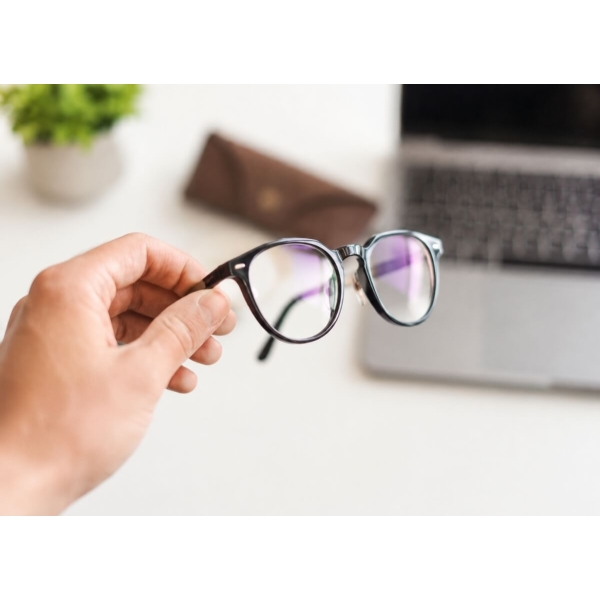
When choosing new prescription glasses, the focus often falls on the eyeglass frames, but true comfort and eye health depend on the eyeglass lenses you select. Two of the most popular options in modern optics are anti-reflective and photochromic coatings. Although both aim to improve the visual experience, they perform fundamentally different functions. In this article, we will examine their characteristics to help you make the best choice for your daily life.
What is Anti-Reflective Coating?
Anti-reflective (AR) coating is a microscopic layer applied to the surface of the lens, whose primary task is to eliminate light reflections. Without this coating, a large percentage of light reflects off the front and back surfaces of your eyeglass lenses, leading to annoying glares.
Key Advantages:
-
Crystal Clarity: Removing reflections allows more light to pass through the lens to the eye, making the image much clearer and more contrasted.
-
Safe Night Driving: AR is critically important for night driving, as it eliminates the "halo" effect around the headlights of oncoming cars and street lamps.
-
Aesthetics: Since the lenses do not reflect light, people facing you see your eyes clearly, rather than their own reflection in your glasses.
-
Reduced Fatigue: These prescription glasses are essential for computer work, as they reduce the strain caused by artificial lighting.
What is Photochromic Coating?
Photochromic lenses (also known as "transition" or "light-adaptive" lenses) are smart lenses that change color depending on the amount of UV radiation and light intensity. Indoors, they are completely clear, just like standard prescription glasses, but when you go out into the sun, they automatically darken, turning into sunglasses.
Key Advantages:
-
Automatic Adaptation: There is no need to switch your prescription glasses for sunglasses every time you step outside.
-
Total UV Protection: Photochromic lenses block 100% of harmful UVA and UVB rays, protecting the delicate skin around the eyes and the retina itself.
-
Visual Comfort in Variable Light: They are ideal for people who spend a lot of time moving between indoor and outdoor spaces.
-
Economy: You essentially get two pairs of glasses in one frame.
Key Differences Between the Two Technologies
The primary difference lies in the purpose of the coating. Anti-reflective coating fights reflections and improves transparency, while photochromic coating fights intense light and UV rays, regulating the amount of light entering the eye.
It is important to note that in modern optics, these two technologies are not mutually exclusive. In fact, the best choice at blink.bg is often a combination of both. A photochromic lens with an added AR layer provides maximum protection outdoors and perfect clarity without glare indoors.
When to Choose Each?
If you spend most of your time in an office, in front of a monitor, or drive primarily at night, a high-quality anti-reflective coating on your eyeglass lenses should be your priority.
However, if you have sensitive eyes, enjoy outdoor sports, or simply want the convenience of "all-in-one" glasses, the photochromic option is indispensable. Modern photochromic lenses darken and clear much faster than older generations, making them extremely practical.
At blink.bg, we believe the right choice begins with understanding your needs. Whether you choose classic AR or smart photochromic lenses, investing in quality prescription glasses is an investment in the health of your vision.
FAQ
Do photochromic glasses darken in the car? Most standard photochromic lenses do not darken enough in the car because the windshield blocks the UV rays that activate the darkening process. However, special series exist (e.g., Transitions XTRActive) that react to visible light and work successfully behind the wheel.
Does anti-reflective coating make lenses harder to clean? Older generations of AR had this problem, but modern coatings in our optics include hydrophobic and oleophobic layers that repel water and grease, making cleaning even easier.
Can anti-reflective coating be applied to photochromic lenses? Yes, and it is highly recommended. The AR coating eliminates internal reflections that can be more noticeable when the photochromic lens is in its darkened state.
How long does the photochromic effect last? Over time (usually 2-4 years), the efficiency of the photochromic molecules may slightly decrease. However, this often coincides with the time you should update your prescription glasses due to changes in your prescription anyway.